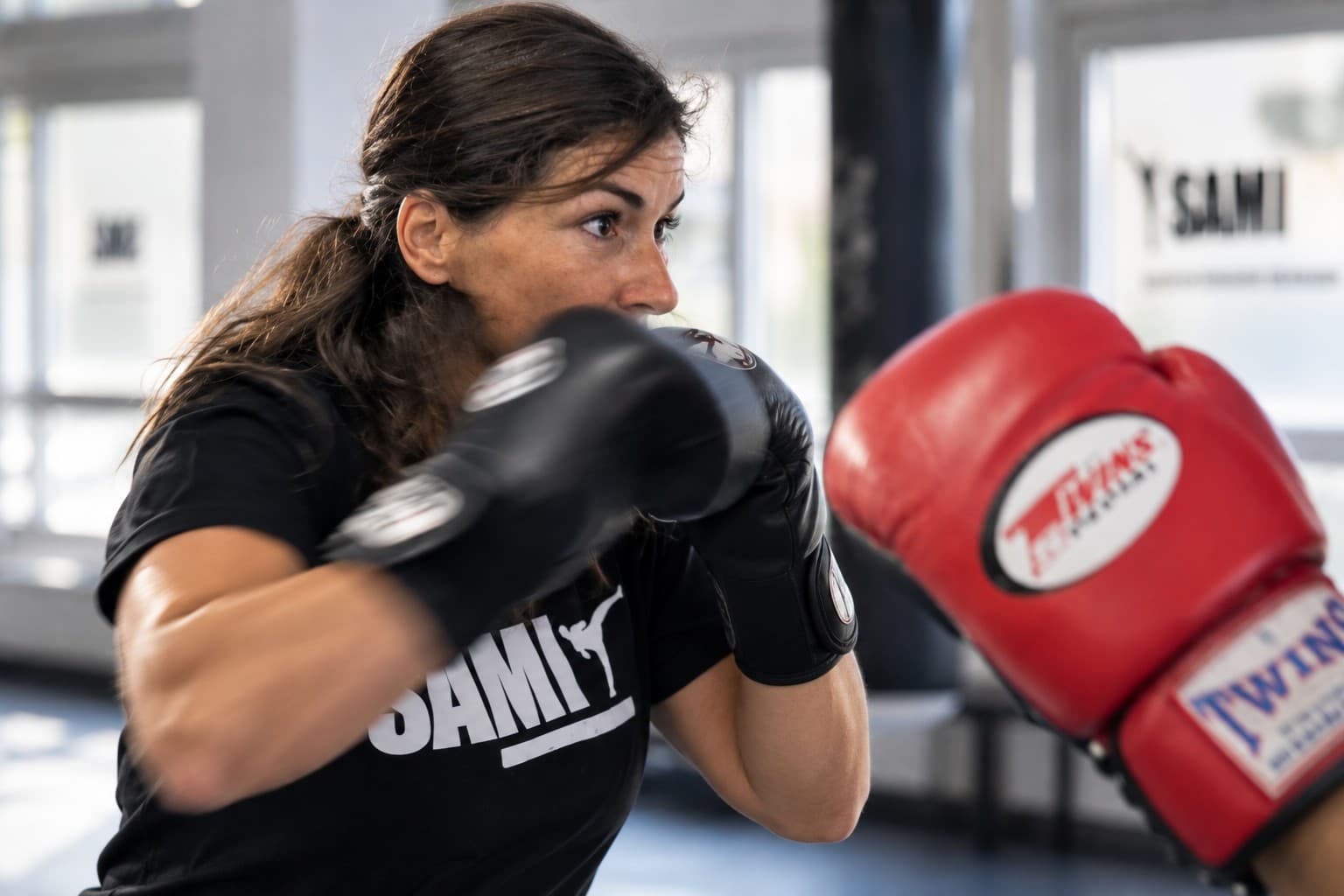
Contents (15 sections)
- Two systems that shaped my life
- What is boxing?
- What is Krav Maga?
- Boxing vs. Krav Maga at a glance
- Why do people train boxing?
- Why do people train Krav Maga?
- The strengths of boxing
- The strengths of Krav Maga
- What boxing cannot do
- What Krav Maga cannot do
- Who wins in a sporting match?
- Who has better chances against a knife attack?
- Who develops more self-confidence?
- Can you combine boxing and Krav Maga?
- My personal conclusion after 25+ years
Two systems that shaped my life
I get asked it again and again: "Peter, which is better – boxing or Krav Maga?"
My answer surprises a lot of people: Both.
I love boxing. And I love Krav Maga. I have been teaching Krav Maga and self-defense for over 25 years. At the same time, I completed a state-certified boxing-instructor qualification in Austria, and I have trained and taught boxing myself for many years.
Both systems have profoundly shaped how I understand fighting, movement, training and self-protection. And yet they pursue different goals.
Comparing boxing with Krav Maga is, in part, comparing apples to oranges. There is overlap, but the focus is different. In this article I want to put both systems side by side honestly – not to crown a winner, but so you can decide which one fits your goals.
In short: Boxing is the more effective sport for striking technique, timing and fitness. Krav Maga is built for real-world self-protection – including weapons, multiple attackers, prevention and de-escalation. In a sporting match the boxer almost always wins; in a real threat the well-trained Krav Maga practitioner has the edge. For most people, the best solution is the combination of both.
What is boxing?
Boxing is one of the oldest combat sports in the world. The goal is clear: land punches on your opponent while taking as few hits as possible yourself.
Boxing is a sport – with rules, protective gear, weight classes and time limits. But that does not make it unrealistic. On the contrary: boxing is probably one of the most effective striking arts there is. Anyone who regularly boxes against an actively resisting opponent develops skills that cannot be replaced by purely theoretical self-defense training.

Boxing thrives on thousands of repetitions against a real, resisting partner.
 Matching this articleKrav Maga - Level 1A complete system, structured drills, a clear progression. Online course, €390
What is Krav Maga?
Krav Maga was originally developed to prepare people for real violent encounters as quickly as possible. The goal is not a sporting victory. The goal is: to get home safely.

Krav Maga trains the defense of real attacks – not a sporting exchange of blows.
That is why Krav Maga deals with far more than just fighting:
- prevention
- de-escalation
- conflict management
- escape strategies
- self-defense
- multiple attackers
- knife attacks
- threat situations
- protecting family members
- behavior after an incident
The actual fight is often only a small part of the entire system.
Boxing vs. Krav Maga at a glance
- Primary goal — Boxing: sporting victory, points · Krav Maga: getting home unharmed
- Context — Boxing: ring, rules, weight classes · Krav Maga: real violence, no rules
- Opponent — Boxing: one opponent · Krav Maga: one or several
- Weapons — Boxing: not part of training · Krav Maga: knife, stick, threat scenarios
- Striking technique — Boxing: very highly developed · Krav Maga: solid, more broadly spread focus
- Prevention & de-escalation — Boxing: not addressed · Krav Maga: core component
- Competition — Boxing: yes · Krav Maga: no
- Fitness effect — Boxing: excellent · Krav Maga: good
Why do people train boxing?
The motivations are varied:
- improve fitness
- lose weight
- compete
- learn technique
- build confidence
- relieve stress
- enjoy sparring
- be part of a community
- increase punching power
- practice a combat sport
Many people never train boxing for a street fight. They train because they love the sport. And that is completely legitimate.
Why do people train Krav Maga?
Here, too, the reasons differ:
- feel safer
- learn self-defense
- protect the family
- reduce fear
- develop the ability to act
- train behavior in dangerous situations
- strengthen self-confidence
- learn to set boundaries
- prepare for occupational risks
- expand existing martial arts experience
Most Krav Maga students never want to have to fight. They want to be prepared.
The strengths of boxing
Timing and sense of distance
If I had to name a single area in which boxing is almost unbeatable, it would be this one. Boxers learn to judge distance, read movement, recognize attacks early, exploit openings and build pressure. These skills do not come from theory. They come from thousands of repetitions.
Realistic training
A big advantage of boxing: you constantly train against resistance. Your partner wants to hit you, your partner moves, your partner does not make mistakes on purpose. This creates a very high degree of realism in training.
Striking technique
Hardly any system develops striking ability as efficiently as boxing. You train the jab, cross, hook, uppercut, combinations, body mechanics, explosiveness and precision. A good boxer usually strikes far more effectively than most people. How to build that striking quality on purpose is something I cover in the article on focus pad training in the SAMI-X system.
Fitness
Boxing improves endurance, speed-strength, strength endurance, reaction time, coordination, mobility and mental resilience. That alone makes boxing training worthwhile.
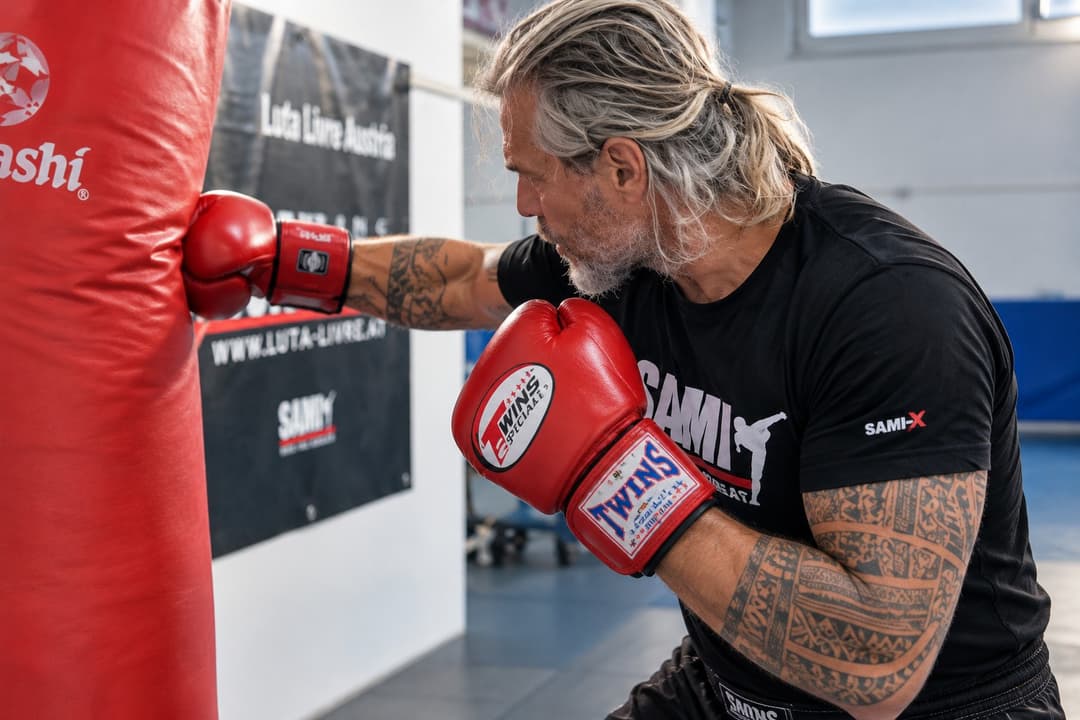
Endurance, speed-strength, coordination: boxing is also excellent fitness training.
The strengths of Krav Maga
Krav Maga looks at situations far more broadly.

Krav Maga thinks in scenarios: distance, cover and counterattack in one motion.
Prevention
The best fight is the one you avoid. That is why Krav Maga deals intensively with recognizing danger, positioning, situational awareness, body language and distance management. These topics are almost entirely missing from many combat sports.
Multiple attackers and weapons
A boxer usually trains against a single opponent. Krav Maga deliberately addresses multiple attackers, escape routes, protecting third parties, tactical movement and weapons. This is one of the biggest differences. Boxing does not deal with knives, blunt weapons, guns or threat situations – Krav Maga trains exactly these areas.
Protecting loved ones
A real dangerous situation often involves more than just you. You might be out with your child, your partner or friends. Krav Maga integrates such scenarios – boxing does not.
What boxing cannot do
Here we have to be honest: boxing has limits. A boxer normally does not train:
- knife defense
- threat situations
- protecting family members
- multiple attackers
- legal aspects
- de-escalation
That does not mean boxers are helpless – a good boxer often has outstanding fighting skills. But certain scenarios are simply never trained.
What Krav Maga cannot do
Krav Maga has limits too. A common mistake in many self-defense schools: too little resistance in training. If no realistic pressure is built up, false expectations often arise.
In addition, many Krav Maga students never reach the striking level of an experienced boxer. Why? Because the focus is spread more widely: Krav Maga trains many topics at once, while boxing concentrates almost entirely on punching.
Who wins in a sporting match?
If the rules are boxing rules: the boxer. Almost always. Why? Because that is exactly what he trains for. He has better striking technique, better timing, better footwork, more sparring experience and better ring tactics. That would be no surprise – no more than a tennis player usually beating a footballer on a tennis court.
Who has better chances against a knife attack?
This question comes up often. The honest answer: nobody has good chances. A knife attack is extremely dangerous.

A knife attack is extremely dangerous – Krav Maga at least trains how to behave.
Still, in this scenario I would give the edge to a well-trained Krav Maga practitioner. Not because his techniques are magic, but because he has at least trained for such situations. He may know escape strategies, covering concepts, distance management, weapon awareness and emergency behavior.
A boxer brings other strengths to the table – movement, explosiveness, reaction time and punching power. These qualities help too, but they do not replace specific training.
Important: There is no guarantee against a weapon – no matter which system you train. The most effective "tool" is always to recognize danger early, keep distance and avoid letting the situation escalate in the first place. That is exactly where Krav Maga starts.
Who develops more self-confidence?
Both – but in different ways:
- The boxer gains confidence through sparring, competition and physical performance.
- The Krav Maga student gains confidence through the ability to act, problem-solving, scenario training and mental preparation.
Can you combine boxing and Krav Maga?
Absolutely. In fact, I consider this combination excellent.
- Boxing provides: striking technique, timing, sense of distance and sparring experience.
- Krav Maga provides: self-protection, tactics, prevention, scenario training and weapon awareness.
The systems complement each other beautifully. Many successful self-defense instructors today deliberately integrate boxing elements into their training.
My personal conclusion after 25+ years
- If your goal is competition, fitness, striking technique and athletic development: train boxing.
- If your goal is self-protection, prevention and preparing for real dangerous situations: train Krav Maga.
And if you ask me what I would recommend: train both. Good boxing training makes many people noticeably better fighters. Good Krav Maga training makes many people more safety-aware and more capable of acting.
The truth is not in an either-or. It often lies in the combination. Because a powerful strike can be helpful – but the ability to recognize danger early, avoid it, or protect your own family is often even more valuable. In the end, training should not only serve to win a fight, but above all to help you go through life healthy, confident and safe.
Key takeaways
- Boxing is a sport focused on striking technique, timing and fitness.
- Krav Maga is a self-protection system including weapons, multiple attackers and prevention.
- In the ring the boxer wins; on the street the Krav Maga practitioner has the edge.
- There is no guarantee against weapons – avoidance beats any technique.
- For most people, combining both worlds is ideal.
Train both – in one system.
On SAMI-X you combine Krav Maga self-defense with solid striking technique – guided by Peter Weckauf and the SAMI team, anytime and anywhere.
About the author: Peter Weckauf has trained and taught Krav Maga and self-defense for over 25 years and is a state-certified boxing instructor in Austria. He is the founder of SAMI-X. More about Peter Weckauf
